
Play Wolf Run Now!
Home → Strategy
Wolf Run Strategy
Approaching Wolf Run sensibly
The theoretical return to player for Wolf Run stands at 94.98%, which establishes a house edge of 5.02% over an extended session. This percentage indicates that the casino retains five cents from every euro wagered in the long run, making it essential for players to understand the built-in mathematical disadvantage before playing. Consequently, bankroll management becomes critical to withstand the variance inherent in this specific return rate.
In contrast to Triple Diamond which offers a higher RTP of 95.06%, Wolf Run presents a slightly steeper cost per spin for the participant. The lower return figure means that losses may accumulate faster compared to games with superior percentages, requiring more disciplined play. Players should recognize this difference when selecting titles, as the 0.08% gap can significantly impact total expenditure over hundreds of spins.
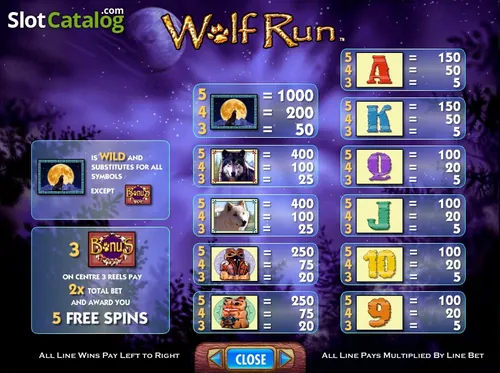
The maximum win potential in Wolf Run is capped at 1000x the stake, providing a clear upper limit on possible payouts during gameplay. This cap applies regardless of volatility or feature triggers, meaning even large wins cannot exceed this predetermined multiplier threshold. Understanding this limitation helps manage expectations and prevents unrealistic assumptions about potential earnings from any single bonus round or free spins sequence.
Bankroll rules that hold up
A sustainable bankroll for Wolf Run should cover at least one hundred times the chosen bet size to endure medium volatility swings effectively. With a base game featuring 40 paylines and stacked wilds, losing streaks are common before hitting significant combinations or triggering the free spins bonus. This buffer ensures that players remain in the game long enough to experience the doubled wins feature without depleting funds prematurely.
When applying flat betting strategies, the constant stake allows for predictable erosion rates based on the 5.02% house edge across thousands of rounds. Progressive staking methods like increasing bets after losses do not alter this mathematical reality but merely accelerate the depletion of the initial deposit. Therefore, maintaining a fixed wager amount provides the most stable approach to managing the bankroll against the game's inherent volatility.
The welcome bonus of 300% up to €2,000 plus 100 free spins can extend playtime if wagering requirements are met through standard bets. However, these bonus funds often come with restrictions that may exclude certain high-variance features or limit withdrawal amounts until turnover targets are reached. Players must calculate whether the extended sessions provided by such promotions justify the potential constraints on withdrawing real money winnings.
Bet sizing against volatility
Wolf Run operates on a 5-reel, 4-row grid with 40 active paylines, requiring bets that align with the medium volatility profile to sustain engagement. Setting stakes too high relative to the bankroll risks rapid ruin due to the unpredictable nature of stacked wilds and free spin triggers. Optimal bet sizing balances the desire for frequent small wins with the need to survive longer periods between larger bonus activations.
Compared to low-volatility titles like Triple Diamond, Wolf Run demands larger buffers because its medium variance produces less frequent but potentially larger payouts. A stake of €0.40 per spin on all forty lines consumes €0.40 per round, impacting the total number of spins achievable with a given budget. This consumption rate directly influences how many opportunities exist to trigger the doubled wins feature within the allocated session timeframe.
Free spins bonuses in Wolf Run double wins, offering a temporary reduction in the effective house edge during those specific rounds. However, the base game maintains the 5.02% advantage, meaning overall profitability still depends heavily on entering these bonus states with sufficient remaining funds. Strategic bet sizing ensures that players have enough capital to reach the scatter symbols required to activate these favorable conditions.
Session limits worth setting
Setting a time limit for Wolf Run sessions helps prevent fatigue-induced errors when navigating the 40 paylines and complex feature mechanics. Medium volatility games require sustained attention to track stacked wilds and anticipate free spin triggers, making mental endurance a key factor in decision-making. Limiting play to ninety minutes ensures that cognitive resources remain sharp, reducing the likelihood of misclicks or misjudgments during critical moments.
Loss limits should be established before starting, considering the 5.02% house edge will eventually erode any bankroll over sufficient time. For instance, stopping after losing fifty percent of the initial deposit preserves half the funds for future attempts rather than chasing deficits. This rule protects against the emotional tilt that often follows consecutive non-winning spins in a medium-variance slot environment.
Win goals provide a positive exit strategy, encouraging players to secure profits after hitting a significant win near the 1000x max payout cap. Recording these targets beforehand creates discipline, preventing the temptation to reinvest winnings into further risky spins hoping for even greater rewards. Implementing this boundary ensures that successful sessions translate into actual financial gains rather than transient digital balances.
Why chasing losses fails
Chasing losses in Wolf Run ignores the independent nature of each spin, where the 94.98% RTP remains constant regardless of previous outcomes. Increasing stakes after defeats does not change the underlying probability of landing winning combinations on the 5-reel, 4-row grid. This misconception leads to accelerated bankroll depletion, as the house edge continues to apply equally to larger wagers made in desperation.
The medium volatility of Wolf Run means that long dry spells are statistically normal and do not indicate an impending bonus trigger. Assuming that a big win is due after several losses violates the principle of independence central to random number generation algorithms. Such beliefs often result in erratic betting patterns that undermine structured bankroll management strategies designed to mitigate risk over time.
Comparing Wolf Run to Triple Diamond highlights how different volatility profiles affect loss recovery timelines, yet neither game guarantees short-term profitability. Even with Triple Diamond's lower volatility and higher RTP of 95.06%, no strategy can overcome the negative expected value inherent in casino games. Accepting losses as part of the entertainment cost prevents destructive behaviors associated with trying to recoup funds through increased betting intensity.
Wolf Run: key facts
| Parameter | Value |
|---|---|
| Game | Wolf Run |
| Studio | IGT |
| RTP | 94.98% |
| House edge | 5.02% |
| Volatility | medium |
| Max win | 1000x |
| Reels | 5 |
| Paylines / ways | 40 |
Common systems and their limits
Wolf Run operates with a theoretical return to player rate of 94.98% according to IGT specifications, establishing a fixed house edge of 5.02% that remains constant regardless of betting patterns or strategy employed by the user during gameplay sessions. This mathematical baseline ensures that long-term results will converge toward this percentage rather than deviating significantly through any external influence or modified wagering approach used by participants. Consequently, no progression system can alter the fundamental expectation built into the game engine over extended periods of play across thousands of rounds. Players should recognize that the statistical advantage always favors the operator in every single transaction.
The maximum win cap for Wolf Run is set at 1000x the total stake amount placed on a single spin, which imposes a strict upper limit on potential payouts regardless of how large the bankroll might be for an individual player. In contrast, White Orchid from IGT offers a slightly higher RTP of 95.03%, demonstrating that even minor differences in design parameters create distinct variance profiles between similar titles from the same developer studio. This distinction means that while both games share medium volatility characteristics, the specific payout structures differ enough to affect short-term session outcomes differently for each participant. The cap prevents exponential growth of winnings beyond this defined threshold in any single round.
Free spins bonus features in Wolf Run include doubled wins, which temporarily improves the effective return during those specific rounds but does not change the overall theoretical return of 94.98% calculated over millions of spins. Stacked wilds appear frequently on the 5-reel/4-row grid to increase hit frequency, yet these mechanics merely redistribute wins rather than creating new value outside the programmed mathematics of the slot machine. Each free spin contributes to the total turnover requirement under standard casino terms without altering the base game volatility profile established by IGT for this specific title. The combined effect maintains the expected loss rate per unit wagered throughout the entire session duration.
Flat betting explained
Flat betting involves wagering the exact same stake amount on every single spin throughout a gaming session, which simplifies bankroll management by eliminating the complexity of adjusting bet sizes based on previous outcomes or streaks. With Wolf Run featuring forty paylines, players must ensure their chosen stake covers all active lines to maximize the probability of triggering stacked wilds or landing winning combinations on the 5x4 grid layout. This consistent approach allows for precise calculation of total expenditure over time, as each spin costs the identical predetermined amount without variation due to progressive adjustments or dynamic betting strategies. The method provides predictable loss rates aligned directly with the 94.98% RTP figure.
The 40 paylines structure of Wolf Run requires minimum bets to activate all winning paths, meaning flat betting ensures full participation in every possible outcome generated by the random number generator within the game engine. Unlike progressive systems that raise stakes after losses, maintaining a constant wager preserves the original bankroll longer by avoiding the rapid depletion caused by increasing exposure during losing streaks. Since the game has medium volatility, flat betting helps smooth out the variance between small frequent wins and larger occasional payouts, keeping the experience stable for players who prefer controlled risk exposure. This strategy aligns perfectly with the 1000x max win limitation by preventing excessive focus on high-risk attempts.
Bankroll longevity under flat betting depends heavily on the initial deposit size relative to the per-spin cost, allowing players to estimate total spins available before funds are exhausted using simple division of total money by stake amount. For example, a €100 bankroll with a €1.00 bet yields approximately 100 spins at the 94.98% return rate, resulting in an expected loss of roughly €5.02 over that sequence. This transparency enables informed decisions about session length and budget allocation without relying on complex formulas or uncertain projections regarding future performance metrics. The simplicity of this method reduces emotional decision-making during gameplay sessions significantly.
White Orchid shares the same medium volatility classification as Wolf Run but differs slightly in its RTP of 95.03%, making flat betting equally applicable for managing expectations across both IGT titles. By sticking to one stake level, players avoid the psychological trap of chasing losses through increased wagers, which statistically accelerates ruin rather than improving chances of recovery or profit generation. The 5x4 grid format ensures that every spin presents identical opportunities for stacked wilds regardless of previous results, reinforcing the independence of each event in the sequence. This consistency supports disciplined play habits that prioritize sustainability over short-term gains.
Progressive staking risks
Progressive staking involves raising the wager amount after each loss in an attempt to recover previous deficits quickly, a strategy that fundamentally misunderstands how the 94.98% RTP of Wolf Run operates independently of bet size changes. Increasing stakes during losing streaks exposes more capital to the 5.02% house edge faster, accelerating bankroll depletion rather than mitigating it through any mathematical advantage or systemic correction mechanism. Since Wolf Run features medium volatility, such aggressive betting leads to severe drawdowns when unlucky sequences persist, leaving players with insufficient funds to continue playing effectively. The 1000x max win cap remains unaffected by these elevated wagers despite the increased risk exposure.
The 40 paylines on Wolf Run mean that doubling stakes after losses multiplies the monetary impact of each subsequent spin, turning moderate deficits into catastrophic ones within just a few consecutive failures. Unlike flat betting, which maintains steady erosion aligned with theoretical expectations, progressive systems create unpredictable spikes in variance that overwhelm even well-funded accounts over extended periods of continuous play. This approach ignores the independence of each spin, falsely assuming that past results influence future outcomes in a negative feedback loop that never actually exists within the RNG framework. Players often abandon the game prematurely due to rapid exhaustion of their initial deposit amounts.
In comparison, White Orchid also exhibits medium volatility with an RTP of 95.03%, yet neither title offers any mechanic that rewards increased betting during downturns, making progressive staking equally ineffective for both slots. The stacked wilds feature in Wolf Run triggers randomly and cannot be influenced by higher wagers, rendering any attempt to manipulate odds through stake escalation completely futile against the programmed mathematics. Since the free spins bonus doubles wins but does not alter the underlying RTP, chasing losses through bigger bets only increases the speed at which the house edge extracts value from the account balance. This pattern typically results in complete bankroll destruction much sooner than conservative approaches would suggest.
What the maths actually allows
The 94.98% RTP of Wolf Run dictates that for every €100 wagered cumulatively, the game returns €94.98 to players over infinite spins, leaving a guaranteed house edge of 5.02% that erodes bankrolls steadily. This theoretical average applies across hundreds of thousands of spins, meaning short-term sessions may deviate significantly but will inevitably converge toward this figure given sufficient volume of gameplay activity generated by users. The 1000x max win cap limits the upside potential, ensuring that even extreme lucky streaks cannot generate unlimited profits beyond this predefined boundary set by IGT for responsible gaming compliance standards. Such constraints protect both operators and participants from unmanageable financial exposure scenarios.
With a 5x4 reel layout and forty paylines, Wolf Run distributes wins across multiple symbols including stacked wilds, creating a medium volatility profile that balances frequency and size of payouts effectively for most player types. Free spins rounds double wins temporarily, offering brief periods of enhanced returns that mask the underlying 5.02% edge until the bonus concludes and normal play resumes without modification to the base game parameters. This structure allows players to experience excitement through occasional large hits while maintaining realistic expectations about long-term profitability, which remains negative regardless of skill level or strategic application during gameplay. The combination of features supports sustained engagement without promising unrealistic outcomes.
White Orchid presents a comparable experience with medium volatility and an RTP of 95.03%, differing only marginally from Wolf Run’s 94.98% return rate in terms of expected loss per unit wagered over time. Both titles utilize similar 5x4 grids and thematic elements designed to keep players engaged through visual appeal rather than mechanical advantages that could shift the mathematical balance in favor of participants. The absence of cash-out buttons or crash mechanics confirms that Wolf Run functions strictly as a traditional slot where outcomes are determined solely by random draws rather than player intervention or timing decisions. This limitation reinforces the inevitability of the house edge prevailing over extended play durations.
Reading variance honestly
Medium volatility in Wolf Run indicates a balanced distribution of wins where players experience regular small payouts interspersed with occasional larger strikes, reflecting the 94.98% RTP over extended periods of continuous play sessions. This characteristic prevents extreme dry spells common in high-variance slots while avoiding the monotony of low-variance games that offer tiny frequent wins without significant excitement or substantial reward potential for engaged participants. The 1000x max win cap serves as a realistic ceiling for single-round payouts, ensuring that even the most fortunate spin cannot disrupt the overall mathematical equilibrium established by IGT for this particular title. Such design choices cater to players seeking steady entertainment rather than high-risk gambling experiences.
The forty paylines structure of Wolf Run allows stacked wilds to trigger frequently, contributing to the medium volatility profile by providing consistent engagement through partial wins that sustain interest during otherwise uneventful stretches. Free spins bonuses with doubled wins offer temporary relief from the 5.02% house edge, creating memorable moments that justify continued play despite the inevitable long-term loss dictated by the theoretical return percentage. Understanding this variance helps players set appropriate expectations for session length and budget allocation, recognizing that luck plays a role in short-term results while mathematics governs long-term outcomes exclusively. This clarity promotes responsible gambling habits among informed participants utilizing the platform responsibly.
Comparing Wolf Run to White Orchid reveals subtle differences in volatility management despite both sharing medium risk profiles and similar 5x4 grid formats from IGT developers, with RTPs of 94.98% versus 95.03% respectively. These minor variations influence how often players encounter winning combinations but do not alter the fundamental reality that the house always retains an edge over time regardless of which specific slot variant is selected for play. The wolf/nature theme enhances immersion without affecting the underlying mathematics, reminding users that aesthetic elements serve marketing purposes rather than providing any competitive advantage in terms of payout frequency or size calculations. Honest assessment of variance prevents unrealistic hopes about overcoming statistical disadvantages through sheer persistence.
Learning the game in demo first
Wolf Run by IGT features a 5-reel/4-row grid with 40 paylines, allowing players to observe mechanics without risking funds. This layout supports stacked wilds and free spins bonus rounds where wins are doubled, providing clear insight into feature triggers. Testing these elements in demo mode helps players understand the medium volatility before committing real money.
The theoretical return (RTP) of 94.98% indicates a house edge of 5.02% over extended play, defining the long-term statistical expectation. Unlike crash games, Wolf Run has no cash-out button, meaning outcomes are determined solely by spin results rather than player timing. Observing this fixed structure in practice reveals how often the wolf/nature theme awards payouts during standard sessions.
Players can compare the 1000x maximum win cap against Da Vinci Diamonds, which offers a higher 5,000x max win on its 5x3 grid. This comparison highlights that Wolf Run provides more frequent but smaller returns compared to titles with larger potential jackpots. Understanding this distinction helps manage expectations regarding payout frequency versus size during initial gameplay exposure.
Adjusting stakes to your budget
Flat betting involves wagering the same stake every round, preserving the bankroll by avoiding progressive staking losses. Progressive staking raises stakes after losses, which shortens the time to ruin without changing the built-in 5.02% house edge. Maintaining a constant bet size ensures the 94.98% RTP plays out statistically rather than accelerating depletion through variance.
A typical session might start with a 1 € stake per spin on the 40 paylines, costing 40 € per round. At this rate, a 100 € bankroll lasts for approximately 2.5 spins before exhaustion if no wins occur. This calculation demonstrates why setting a strict loss limit is essential when engaging with medium volatility slots like Wolf Run.
Comparing this approach to Da Vinci Diamonds, which shares IGT as its developer but uses a 5x3 grid, shows similar cost structures despite different reel layouts. Both games require players to account for the total bet per spin rather than just the base coin value. Adjusting stakes to fit the bankroll prevents rapid depletion and allows for longer engagement with the 5-reel/4-row grid.
Recognising a bad session
A session becomes unfavorable when consecutive losses drain the bankroll below 20% of the starting amount within the first hour. With a 5.02% house edge, such rapid depletion suggests negative variance exceeding normal statistical expectations for medium volatility. Players should monitor their remaining balance closely to identify when luck deviates significantly from the 94.98% RTP projection.
Tracking the number of spins played versus the total amount lost provides a clear metric for session health. If a player has completed 500 spins on Wolf Run and lost 60 € from a 100 € bankroll, the actual return falls far below the theoretical average. This discrepancy indicates a temporary run of bad luck that may not recover within the remaining budget limits.
Unlike Da Vinci Diamonds, which also features IGT design but offers a 5,000x max win, Wolf Run’s 1000x cap limits recovery potential during dry spells. Players cannot rely on rare large wins to offset prolonged losses because the maximum payout is lower. Recognizing this limitation helps players accept short-term deficits as part of the medium volatility experience without chasing losses.
Stopping while ahead
Exiting the game when the bankroll increases by 50% above the starting amount locks in profits before variance erodes gains. For example, starting with 100 € and reaching 150 € represents a successful session given the 5.02% house edge. Setting a hard stop-loss and take-profit rule prevents emotional decisions that often lead to giving back winnings.
The 1000x maximum win cap means even a lucky streak yields finite returns, making disciplined withdrawal crucial. A player hitting a 500x win on a 1 € bet earns 500 €, but continuing to play risks losing this profit due to the inevitable house edge. Stopping immediately preserves the gain rather than exposing it to further statistical erosion over hundreds of additional spins.
Comparing this strategy to Da Vinci Diamonds, which has a higher 5,000x max win potential, shows that larger jackpots require stricter exit rules. Wolf Run’s lower cap necessitates earlier intervention to secure modest profits since big wins are less frequent. Implementing automatic withdrawal triggers ensures players leave with positive results rather than waiting for unrealistic outcomes.
DemoRTP & VolatilitySymbols & PayoutsBonus FeaturesStrategyBonusesMobileDownload & AppMax WinSimilar GamesReviewFAQSitemap
Wolf Run 2026